
How Long Does Loose-Leaf Tea Stay Fresh? A Guide to Storing Tea Properly
Does loose-leaf tea expire? Learn how long tea stays fresh, the best way to store it, and the simple things that can help protect its flavor and aroma.
You open a jar of tea you haven't brewed in months.
It still looks perfectly fine.
But is it?
Unlike a carton of milk hiding suspiciously at the back of the refrigerator, dry loose-leaf tea doesn't usually announce that it's past its prime.
There may be no obvious change at all.
Instead, something much quieter happens.
The aroma becomes less pronounced. The flavors aren't quite as lively. That beautifully fragrant tea you remember begins producing a cup that tastes. . .well, a little less interesting.
So how long does loose-leaf tea actually stay fresh?
And just as importantly, what can you do to keep it tasting its best?
Fortunately, good tea storage isn't complicated.
Does Loose-Leaf Tea Expire?
You'll often find a best-by date on packaged tea, but that date isn't necessarily the same thing as a food becoming unsafe the moment the calendar changes.
Properly stored dry tea is generally a shelf-stable product.
What tends to decline over time is quality.
Tea contains aromatic compounds responsible for many of the flavors and fragrances we enjoy in the cup.
Over time, and particularly when tea is exposed to unfavorable storage conditions, those qualities can diminish.
So when we're talking about the shelf life of loose-leaf tea, the more useful question is often:
How long will this tea taste its best?
That's where storage makes an enormous difference.
How Long Does Loose-Leaf Tea Stay Fresh?
There isn't one expiration date that applies to every tea.
Black, green, white, and oolong teas are processed differently, and herbal and fruit blends can contain everything from dried flowers to pieces of fruit and spices.
As a practical rule for everyday tea drinkers, many properly stored loose-leaf teas are best enjoyed within roughly one to two years, although some delicate teas can lose their freshness sooner and certain teas can remain enjoyable much longer.
Green teas, for example, are often prized for particularly fresh, vegetal characteristics and may show changes sooner than more heavily oxidized teas.
Black teas tend to be more forgiving.
Some oolongs can retain their character remarkably well.
And herbal or fruit blends vary depending on their ingredients.
Rather than becoming overly concerned with a precise number of months, pay attention to the tea itself.
Smell it. Look at it. Brew it.
Your senses can tell you quite a bit.
The Five Things Tea Doesn't Particularly Like
If you want your loose-leaf tea to stay flavorful, remember five things:
Air. Light. Heat. Moisture. Strong odors.
Protect your tea from those and you've already mastered most of tea storage.
1. Air
Repeated exposure to air can gradually affect the compounds responsible for a tea's flavor and aroma.
That's why tea should be kept in a container that closes securely rather than left indefinitely in an open package.
You don't need laboratory-grade vacuum storage for your everyday tea collection.
You simply want to minimize unnecessary exposure.
Open the container.
Scoop out what you need.
Close it again.
Easy.
2. Light
Prolonged exposure to strong sunlight isn't ideal for maintaining quality.
Light can contribute to chemical changes in foods, including tea.
Store your tea jar inside a cabinet, pantry, or another area away from direct sunlight rather than leaving it on a sunny windowsill.
3. Heat
Tea prefers a relatively cool, stable environment.
That doesn't mean most tea belongs in the refrigerator.
In fact, everyday refrigeration can introduce another problem we'll discuss in a moment.
Instead, choose a pantry or cabinet away from major heat sources.
That means the cabinet directly above the stove may not be your best option.
Neither is the sunny shelf beside it.
A cool, dry cupboard is wonderfully unexciting, and your tea will appreciate it.
4. Moisture
If there's one thing dry tea really doesn't need, it's water arriving before brewing day.
Tea leaves and dried botanical ingredients can absorb moisture from the surrounding environment.
Excess moisture can damage quality and, under sufficiently poor storage conditions, potentially allow microbial growth.
That's why dry hands and dry utensils matter.
Don't scoop tea with a damp spoon.
Don't leave the container open beside a steaming kettle.
And make sure your storage container is completely dry before refilling it.
Save the water for the teapot.
5. Strong Odors
Tea is remarkably good at absorbing aromas.
That's wonderful when those aromas are intentionally introduced during tea production—jasmine tea is a beautiful example.
It's considerably less wonderful when the aroma comes from whatever happens to be sharing your pantry.
Tea stored beside strongly scented foods or spices can pick up unwanted odors over time, particularly if the container isn't well sealed.
So although tea and garlic may happily coexist in the same kitchen, they probably don't need to become close friends.
What's the Best Container for Loose-Leaf Tea?
A good tea-storage container should help protect its contents from the surrounding environment.
Look for a container that:
- closes securely
- stays dry
- doesn't transfer unwanted odors or flavors
- can be kept away from direct sunlight and heat
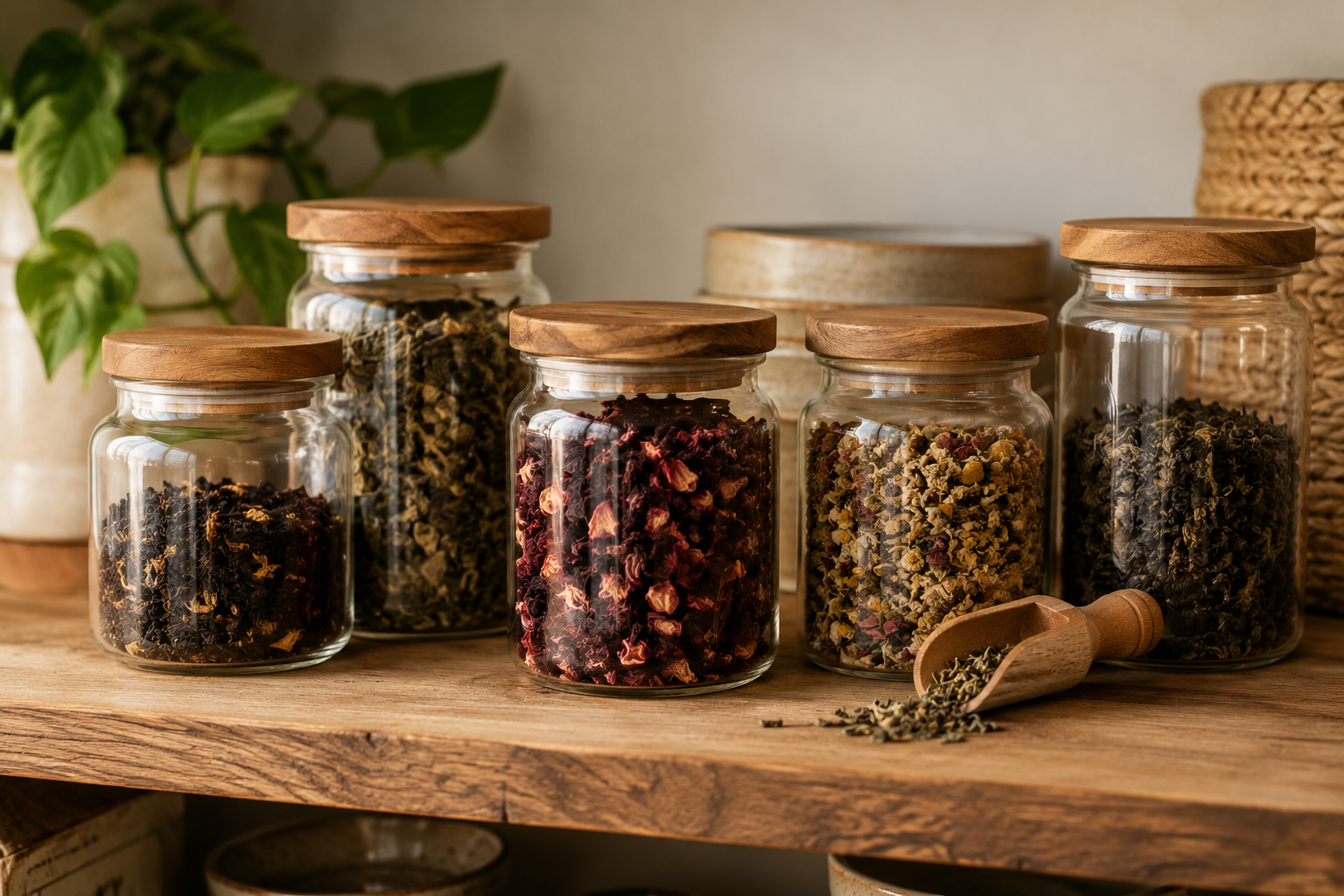
Metal tins and glass containers are popular because they are nonporous, don't readily absorb odors, and glass containers allow you to see the beautiful ingredients inside.
Sometimes good storage is less about finding the perfect container and more about choosing the right place to put it.
Why Tea Ranch Uses Glass Jars
Packaging was something we thought about carefully when creating Tea Ranch.
Loose-leaf tea is beautiful.
You can see curled tea leaves, flower petals, pieces of fruit, herbs, and botanicals—and we didn't particularly want to hide all of that inside disposable packaging. We also wanted something reusable, less wasteful.
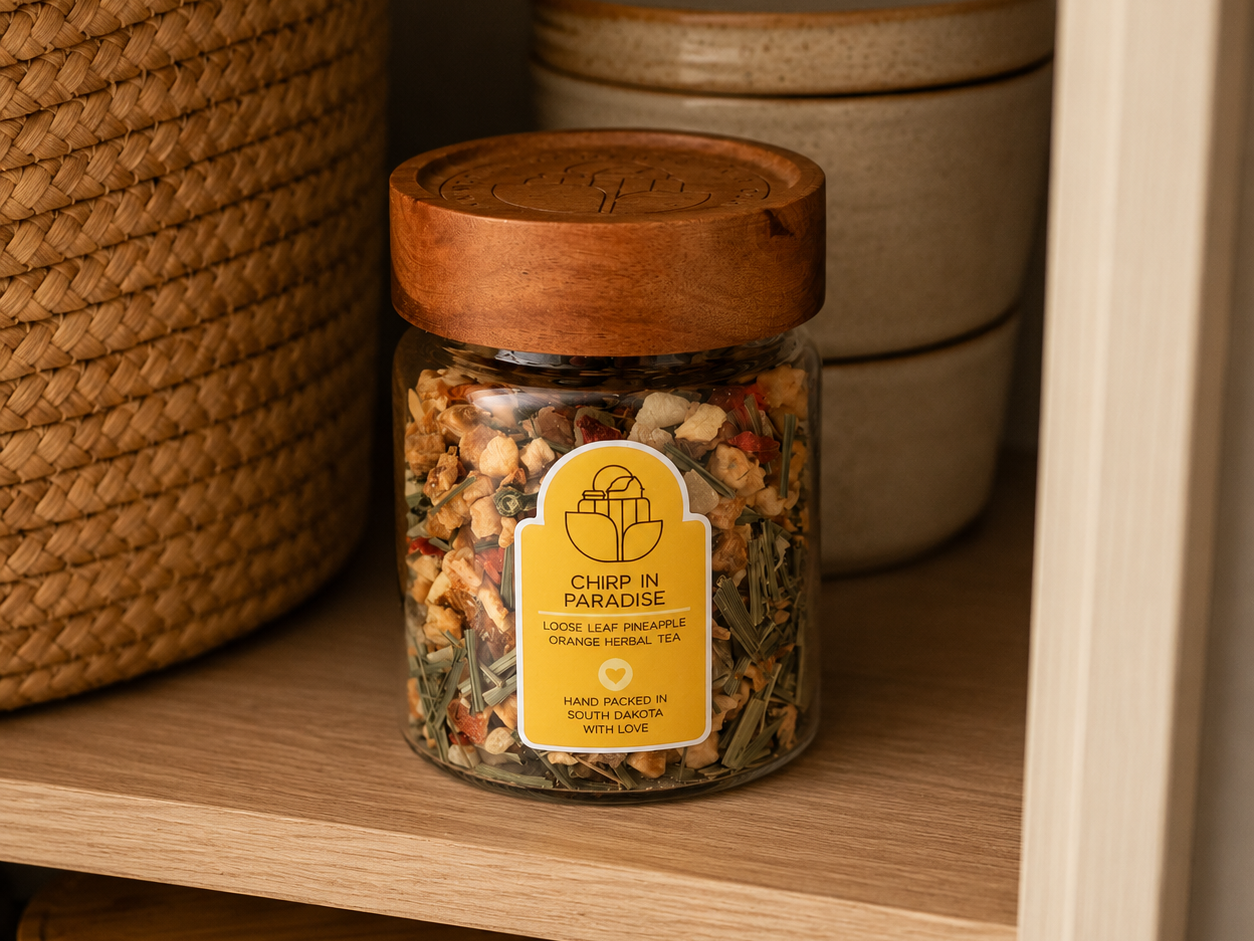
So Tea Ranch teas are packaged in reusable glass jars with natural acacia wood lids.
The jar becomes part of the experience.
You can see the blend you're about to brew, and once the tea is gone, the container doesn't have to be.
Reuse it for tea, spices, dried herbs, small pantry ingredients, or whatever else finds a home there.
For tea storage, we recommend keeping your Tea Ranch jar closed and in a cool, dry place away from direct sunlight.
Pretty and practical can get along quite nicely.
Should You Store Loose-Leaf Tea in the Refrigerator?
For most everyday loose-leaf tea, the refrigerator isn't necessary and can actually create complications.
Why?
Moisture and odors.
Refrigerators are humid environments filled with food aromas.
Moving a cold container in and out can also cause condensation to form, exactly what you don't want around dry tea leaves.
Specialty teas are sometimes refrigerated or frozen by producers and serious tea enthusiasts using carefully controlled, sealed storage methods.
That's different from putting an opened jar of everyday loose-leaf tea beside the leftover lasagna.
For most home tea drinkers, a cool, dry pantry or cabinet is simpler.
Can You Store Different Teas Together?
You can certainly keep different tea containers beside one another.
What you generally don't want to do is combine different loose teas in the same container unless you're deliberately creating a blend.
Tea varieties can have very different aromas.
A delicate green tea stored loose alongside a strongly scented fruit blend isn't necessarily going to remain quite so delicate.
Separate containers help each tea retain its own character.
They also prevent the unfortunate moment when you realize you have accidentally invented Strawberry Earl Grey Jasmine Peach Surprise.
Although someone would probably drink it.
How Can You Tell If Tea Is No Longer Fresh?
Start with your senses.
Smell
Fresh aromatic tea should smell like something.
If a once-fragrant blend has very little aroma left, its quality may have faded.
Appearance
Look for anything unusual.
Tea that has been exposed to moisture and shows signs of mold should be discarded.
Taste
Sometimes the biggest clue is simply the cup.
If the tea smells normal and appears dry but tastes noticeably flatter than you remember, it may simply be past its peak freshness.
That doesn't necessarily mean something dramatic has happened.
Tea gets older.
So do the rest of us.
What About Flavored Loose-Leaf Tea?
Flavored teas deserve a little extra attention because part of their character comes from aromatic flavor components in addition to the tea leaves and other ingredients.
Those aromas can become less pronounced over time.
The same general storage rules apply:
Keep the tea sealed, cool, dry, and away from light and strong odors.
And perhaps most importantly: drink it.
Tea is meant to be enjoyed, not preserved indefinitely because the jar looks too pretty to open.
Don't Forget About the Tea in Your Cupboard
Here's a small Tea Ranch challenge.
Open your tea cupboard sometime this week.
Take everything out.
Yes, everything.
You'll probably discover at least one tea you had completely forgotten about.
Check the dates. Smell the leaves. Wipe out the shelf.
Move anything sitting near excessive heat or sunlight.
Then choose one forgotten tea and brew it.
Perhaps it's still wonderful.
Perhaps it's time to replace it.
Either way, you've just made your tea cupboard a little more intentional.
Good Tea Deserves a Good Home
Tea doesn't require complicated equipment or elaborate storage rituals.
Mostly, it asks for a few simple things:
Keep it dry.
Keep it away from excessive heat and sunlight.
Protect it from strong odors.
Close the container when you're finished.
And don't forget it's there.
Because the best way to prevent beautiful loose-leaf tea from becoming old and forgotten isn't finding the world's most sophisticated storage system.
It's making yourself a cup.
Happy steeping,
Annika
Founder, Tea Ranch