
How Much Loose-Leaf Tea Per Cup? A Simple Measuring Guide
Teaspoons, tablespoons, grams—brewing instructions can make a simple cup of tea sound surprisingly complicated. Here’s an easier way to measure loose-leaf tea and adjust it to the cup you actually enjoy.
You have the kettle ready.
Your favorite mug is waiting.
You open a beautiful jar of loose-leaf tea and then encounter a deceptively simple question:
How much tea should I use?
One teaspoon?
Two?
A tablespoon?
And what happens when your tea contains enormous flower petals and pieces of fruit that barely fit inside the teaspoon in the first place?
If you've ever wondered whether you're measuring loose-leaf tea correctly, you're in good company.
The good news is that brewing tea doesn't require laboratory precision.
There are useful starting points, but your perfect cup ultimately comes down to the tea you're brewing and how you like to drink it.
The Simple Answer: Start with About 1 Teaspoon Per Cup
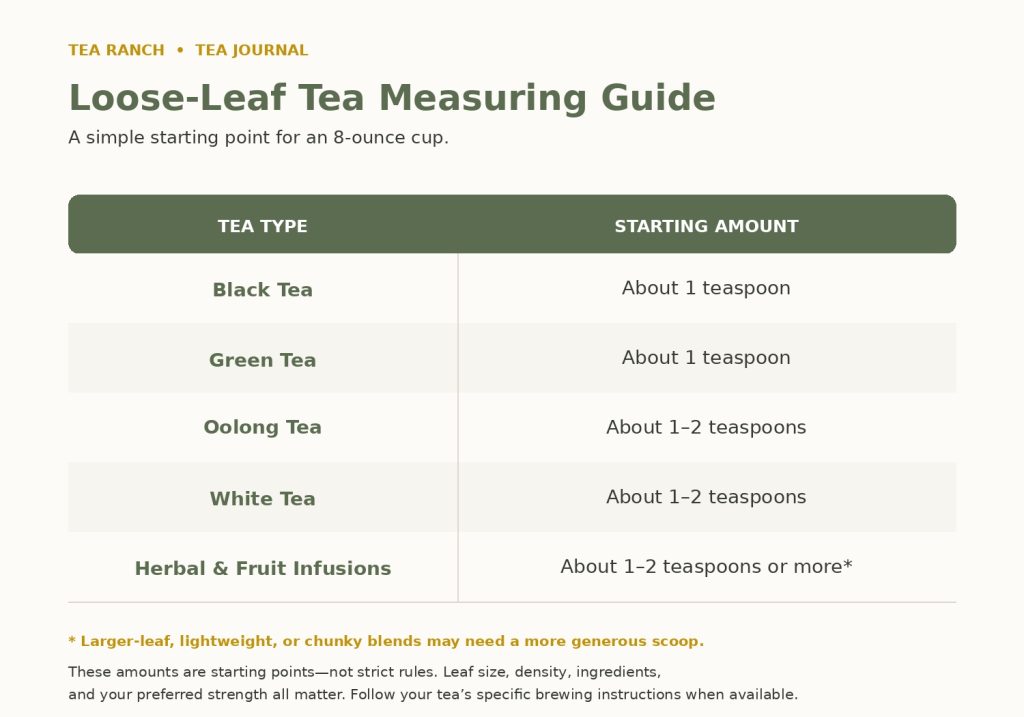
For many loose-leaf teas, a good starting point is approximately:
1 teaspoon of loose-leaf tea per 8 ounces of water.
From there, adjust according to the tea and your taste.
For larger-leaf, particularly lightweight, or chunky herbal and fruit blends, you may need more volume—sometimes closer to 1–2 teaspoons or even a tablespoon per cup.
That's why "one teaspoon" is a starting point rather than a universal tea law.
Tea leaves come in remarkably different shapes and sizes.
And that changes everything.
Why One Teaspoon of Tea Isn't Always One Teaspoon of Tea
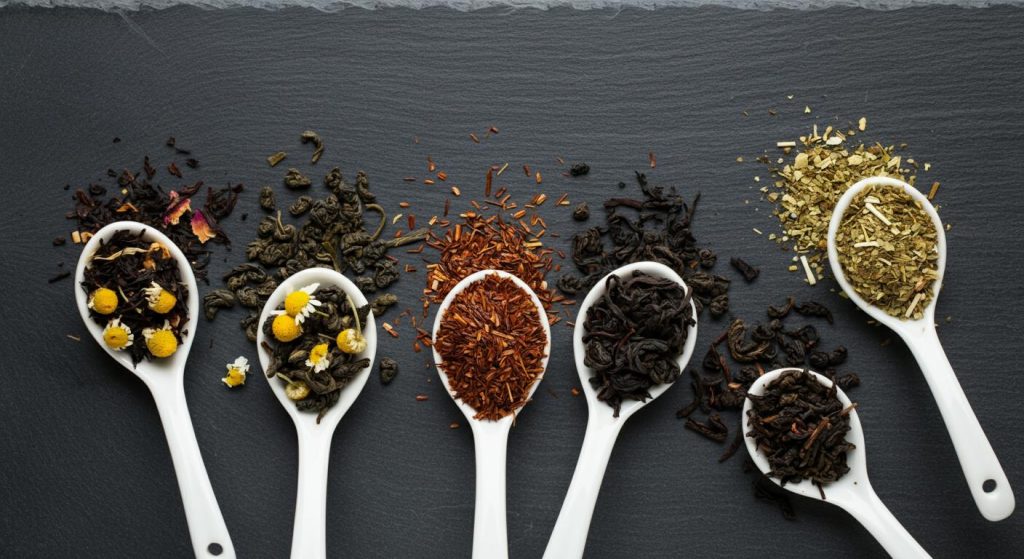
Imagine measuring a teaspoon of fine black tea.
The small leaves settle closely together, so quite a bit of tea can fit onto your spoon.
Now imagine measuring a teaspoon of a chunky fruit infusion containing pieces of apple, hibiscus, berries, and flowers.
There may be only a handful of ingredients balancing on that same spoon.
Both are technically one teaspoon.
But they may have very different weights.
That's one reason brewing instructions sometimes seem inconsistent.
Measuring tea by volume is wonderfully convenient, but it isn't especially precise.
Fortunately, your kitchen has another option.
Measuring Loose-Leaf Tea by Weight
If you'd like greater consistency, use a small kitchen scale.
For many traditional teas, roughly 2–3 grams of tea per 8 ounces of water is a useful Western-style brewing starting point.
But once again, the specific tea matters.
A dense rolled oolong and a fluffy white tea can occupy very different amounts of space while weighing exactly the same.
Measuring by weight eliminates that difference.
Does that mean you need to weigh your tea every morning?
Absolutely not. Unless you enjoy doing it.
A scale can be helpful when you're learning how much of a particular tea produces the cup you like. After brewing it a few times, you'll probably become quite good at estimating the right amount with your usual spoon.
Tea should make your morning nicer.
It shouldn't feel like chemistry homework.
If your tea comes with specific brewing instructions, use those first.
But My Mug Isn't 8 Ounces
This is where many brewing guides quietly become less useful.
Take a look at your favorite mug.
There's a good chance it holds considerably more than eight ounces.
If you're filling a 12-ounce mug but measuring tea for an 8-ounce cup, your finished tea may taste weaker than intended.
Instead, scale the amount of tea to the amount of water you're actually using.
If your starting ratio is one teaspoon per eight ounces, a larger mug needs proportionally more tea.
You don't have to calculate this to the decimal point.
Just remember: More water needs more tea.
That simple adjustment can improve a disappointing cup enormously.
What If My Tea Tastes Too Weak?
The first instinct is often:
Steep it longer.
Sometimes that works.
But particularly with black, green, white, and oolong teas, dramatically extending the steeping time can extract more bitterness and astringency along with additional flavor.
Instead, try adding more tea leaves while keeping the recommended steeping time approximately the same.
That's the same principle we discussed in our guide to making loose-leaf iced tea.
If a cup tastes weak, don't automatically punish those poor leaves with another five minutes underwater.
Give them some reinforcements.
What If My Tea Tastes Too Strong?
You have several options.
Use slightly less tea next time.
Reduce the steeping time.
Or, if you've already brewed the cup, add a little hot water.
Tea brewing is forgiving.
One overly enthusiastic scoop doesn't mean the cup is ruined.
And after a few attempts with the same tea, you'll begin to know instinctively how much you prefer.
That's one of the pleasures of loose leaf.
Does Water Temperature Matter Too?
Very much.
The amount of tea is only one part of brewing.
Water temperature and steeping time also influence what ends up in your cup.
A green tea brewed with cooler water can taste completely different from the same leaves brewed with boiling water.
Likewise, a black tea steeped for two minutes will not necessarily taste like one steeped for five.
If you're new to loose leaf, don't try to perfect every variable at once.
Start with the recommended:
amount + temperature + time
Then change one thing at a time.
That way, you'll actually know what improved the cup.
Our Tea Journal guide to brewing the perfect cup of loose-leaf tea goes deeper into water temperatures and steeping times.
Why Herbal and Fruit Teas Can Look Like So Much Tea
Open a fruit or herbal blend and you may find an entire miniature garden inside.
Flowers.
Fruit pieces.
Herbs.
Spices.
Leaves.
Some of those ingredients are extremely lightweight and take up a lot of room.
That's why a generous spoonful of a colorful herbal blend may actually weigh less than a much smaller-looking spoonful of dense tea leaves.
It also explains why measuring instructions for herbal and fruit infusions often call for a larger scoop.
Don't be alarmed if your infuser looks quite full.
That may be exactly what the blend needs.
Give Your Tea Room to Move
How much tea you use matters.
So does where you put it.
Tea leaves absorb water and expand as they steep. Some tightly rolled teas can unfurl dramatically.
If the leaves are crammed into a tiny infuser with very little room, water can't circulate around them as freely.
Choose an infuser or teapot that gives the leaves space to open.
This is one of the fundamental differences between loose-leaf tea and the conventional tea bag we explored in our Loose-Leaf Tea vs. Tea Bags article.
Loose leaf isn't just about seeing prettier ingredients.
You're giving those ingredients room to brew.
Can You Re-Steep Loose-Leaf Tea?
Often, yes.
Many high-quality traditional teas—particularly certain oolongs, green teas, white teas, and some black teas—can produce enjoyable additional infusions.
The second steep won't necessarily taste identical to the first.
That's part of the fun.
Some flavors soften.
Others become more noticeable.
If you'd like to re-steep your leaves, increase the steeping time slightly and see what happens.
Not every flavored, herbal, or fruit blend performs equally well on a second infusion, but there's very little downside to experimenting.
The worst that happens? You make a weak cup of tea.
We've survived worse afternoons.
Should You Use a Tea Scoop or Measuring Spoon?
Either is perfectly fine.
A dedicated tea scoop is lovely if you enjoy the ritual of preparing tea, but it isn't essential.
A regular kitchen teaspoon works.
A small scale works.
Eventually, your eyes may work surprisingly well too.
What's more important is consistency.
Use approximately the same amount of tea, water, temperature, and steeping time each time you brew a new tea.
Once you've found a combination you love, remember it.
That's your recipe.
There's No Prize for Brewing Tea "Correctly"
Brewing guides are useful.
We write quite a few of them.
But they're supposed to help you make a cup you enjoy—not establish rules you have to follow.
If the package says one teaspoon and you prefer two? Use two.
If you like your black tea strong enough to stand up to cream and sugar? Make it stronger.
If you prefer a delicate white tea even lighter than recommended? That's your cup.
One of the advantages of loose-leaf tea is precisely this ability to adjust the experience.
You decide how much. You decide how long. You decide what tastes good.
Start with the Guide. Finish with Your Taste Buds.
The next time you open a jar of loose-leaf tea, don't worry too much about achieving the mathematically perfect scoop.
Start with the recommended amount. Give the leaves enough room.
Use the appropriate water temperature and steeping time.
Then taste.
Too weak? Add a little more tea next time.
Too strong? Use a little less.
Just right? Congratulations.
You've found the most important tea measurement of all:
Yours.
Happy steeping,
Annika
Founder, Tea Ranch