
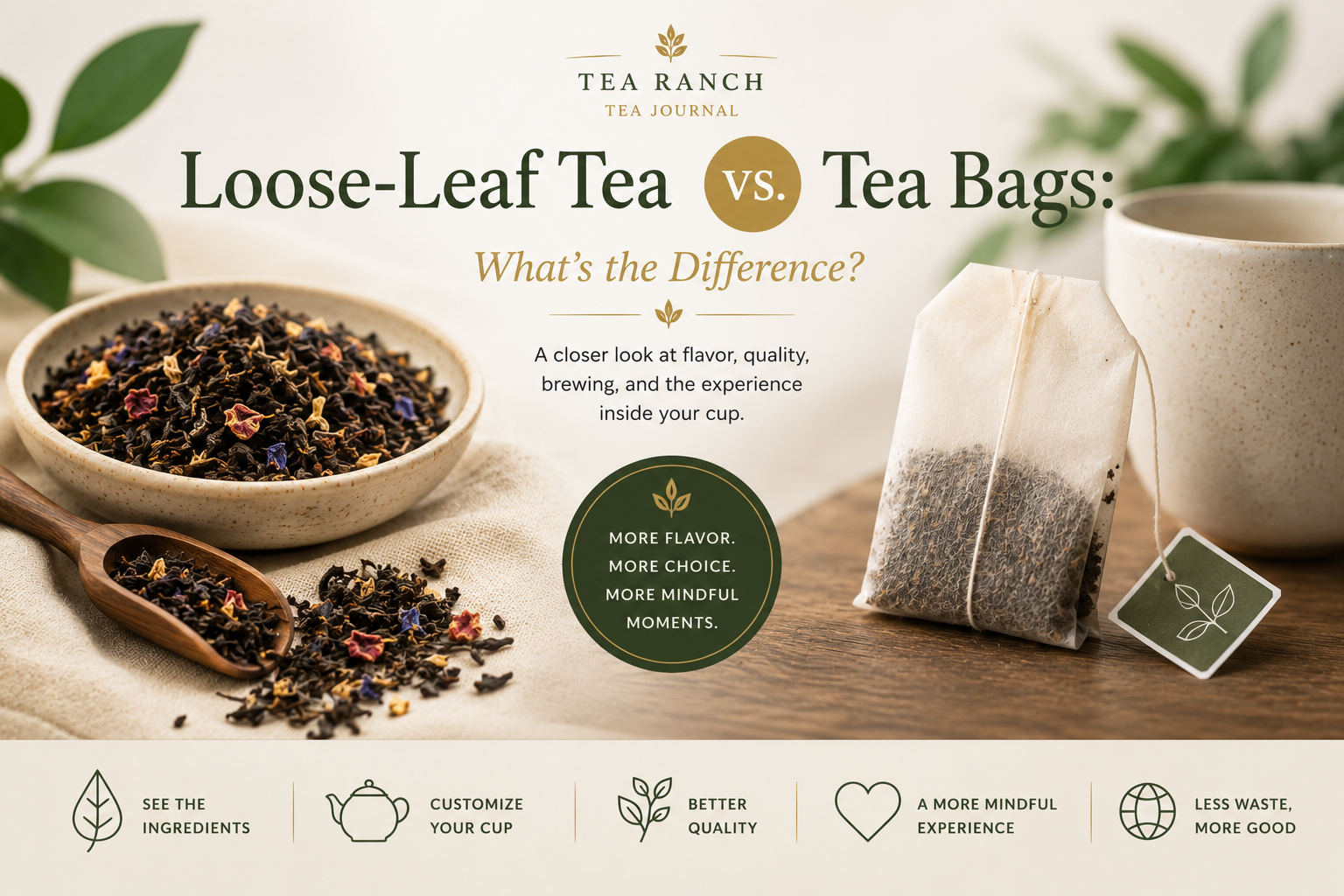
Loose-Leaf Tea vs. Tea Bags: What’s the Difference?
Both make a cup of tea. . .but the leaves, flavor, brewing experience, and convenience can be surprisingly different.
For many of us, tea bags were our first introduction to tea. They're familiar, convenient, and wonderfully simple: drop one into a mug, add hot water, and you're done.
Then you open a jar of loose-leaf tea.
Instead of a little paper pouch, you see actual tea leaves, pieces of fruit, flowers, herbs, spices, or other botanicals.
As the tea steeps, the leaves begin to unfurl and the ingredients come to life in the water.
So, is loose-leaf tea better than tea bags? And what exactly is the difference?
The answer is a little more nuanced than you might think.
Tea bags certainly have their place, especially when convenience matters.
But if you're looking for more variety, a fuller sensory experience, and the pleasure of seeing what you're actually brewing, loose-leaf tea has a lot to offer.
Let's take a closer look.
What Is Loose-Leaf Tea?
Loose-leaf tea is simply tea that is sold without being portioned into individual tea bags.
Depending on the blend, you might find whole or broken tea leaves alongside flowers, herbs, dried fruit, spices, or other ingredients.
Because the tea isn't confined inside a small bag, the leaves have more room to move and expand as they absorb water.
You measure the amount you want, place it in an infuser or teapot, add water, and allow it to steep.
It's a traditional way of preparing tea, and one that gives you a little more control over your cup.
What's Inside a Tea Bag?
Tea bags can contain many different grades and types of tea.
Some premium tea bags contain relatively large leaves and high-quality ingredients.
Others contain much smaller pieces of tea leaf, often referred to within tea grading as fannings or dust.
Smaller particles have greater surface area exposed to the water, which means they can infuse quickly.
That's convenient when you want a fast cup, although the resulting flavor can differ from tea brewed with larger leaf pieces.
So it's worth clearing up a common misconception:
Tea bags aren't automatically “bad,” and loose-leaf tea isn't automatically “good.”
The quality of the tea itself matters.
The biggest differences are often the size and quality of the ingredients, the space they have to steep, and how much control you have over the brewing process.
1. Loose Leaves Have Room to Expand
This is one of the most noticeable differences when brewing loose-leaf tea.
Tea leaves absorb water and expand during steeping. Some tightly rolled teas unfurl dramatically, while larger white and green tea leaves may gently open and soften.
A roomy infuser or teapot allows water to circulate freely around those leaves.
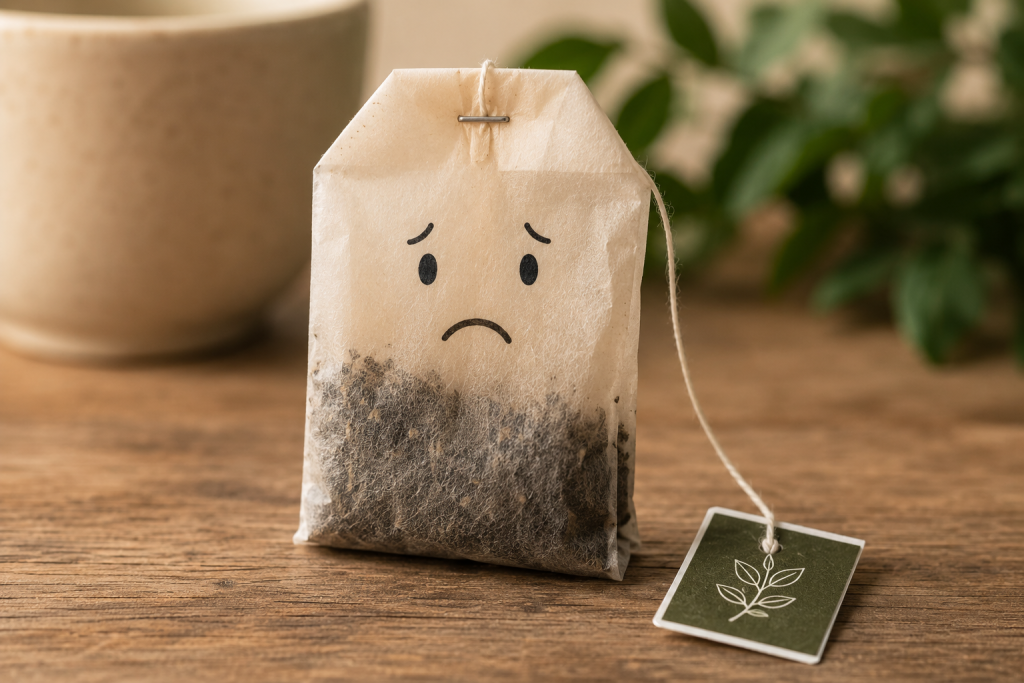
Traditional tea bags provide considerably less space.
While that works well for finely cut tea, larger leaves can be constrained inside a small bag.
If you're brewing loose-leaf tea, this is also why we recommend using an infuser large enough to give your tea some room rather than packing it tightly into a tiny tea ball.
2. The Flavor Can Be More Complex
One of the joys of loose-leaf tea is discovering just how much variety can exist in a cup.
Depending on what you're drinking, you might notice floral, grassy, malty, fruity, toasted, earthy, creamy, or naturally sweet characteristics.
Larger tea leaves can release their flavor gradually as they steep, while finely cut tea infuses more rapidly.
That doesn't mean you'll always prefer loose-leaf tea.
Taste is personal.
But loose leaf tea can offer a particularly interesting experience because you can adjust the amount of tea, water temperature, and steeping time until you find the balance you enjoy most.
And that brings us to another advantage.
3. Loose-Leaf Tea Gives You More Control
With a tea bag, your portion has already been decided for you.
Loose-leaf tea lets you decide.
Want a stronger morning cup? Add a little more tea.
Prefer something delicate in the afternoon? Use a little less.
Brewing a large teapot instead of a single mug? Measure accordingly.
You can also experiment with water temperature and steeping time.
If you're new to loose leaf, a good starting point is generally 1–2 teaspoons of tea per 8 ounces of water, although the ideal amount varies considerably depending on the size and density of the leaves and other ingredients.
That's why we always recommend following the brewing directions for the particular tea you're making first, then adjusting from there.
4. You Can See What You're Drinking
This may be my favorite difference.
Open a loose-leaf blend and you can actually look at the ingredients.
You might see long tea leaves, bright flower petals, pieces of dried fruit, herbs, or spices.
You can smell the blend before you've even heated the water.
There's something satisfying about that transparency.
And as the ingredients steep, you can watch them change: the leaves unfurl, flowers hydrate, fruit softens, and the water gradually takes on its color.
It turns making tea into a sensory experience rather than simply a means of producing a beverage.
5. Loose Leaf Can Mean Less Single-Use Packaging
Tea bags are individually portioned for convenience, and depending on the brand, that can involve a bag, string, tag, wrapper, envelope, or other packaging.
While many traditional tea bags are paper-based, some premium pyramid-style tea bags are made from synthetic materials that may contain microplastics.
Research on this topic is ongoing, and the National Library of Medicine features an article titled "Health Risks Posed by Microplastics in Tea Bags: Microplastic Pollution – A Truly Global Problem," which examines concerns surrounding microplastic release from some plastic-containing tea bags and encourages further study of potential long-term effects.
Loose-leaf tea eliminates the need for an individual bag for every cup.
You'll still need an infuser or strainer, of course, but those can be washed and reused over and over again.
And once you've finished brewing, the spent tea itself can generally be discarded with other food waste.
If you compost at home, whether a particular blend belongs in your compost will depend on its ingredients and your composting setup.
For anyone interested in reducing little pieces of single-use packaging in their daily routine, loose leaf can be an appealing alternative.
6. Some Loose-Leaf Teas Can Be Steeped Again
Here's a bonus many people don't realize when they first discover loose-leaf tea:
Don't always throw those leaves away after the first cup.
Many loose-leaf teas, particularly oolongs, greens, and some white teas, can produce enjoyable second or even subsequent infusions.
The next steep may taste slightly different from the first. Sometimes different flavors and aromas become more noticeable.
Not every tea blend is equally well suited to multiple infusions, but it's worth experimenting.
Your leaves may have another cup in them.
So, Are Tea Bags Ever the Better Choice?
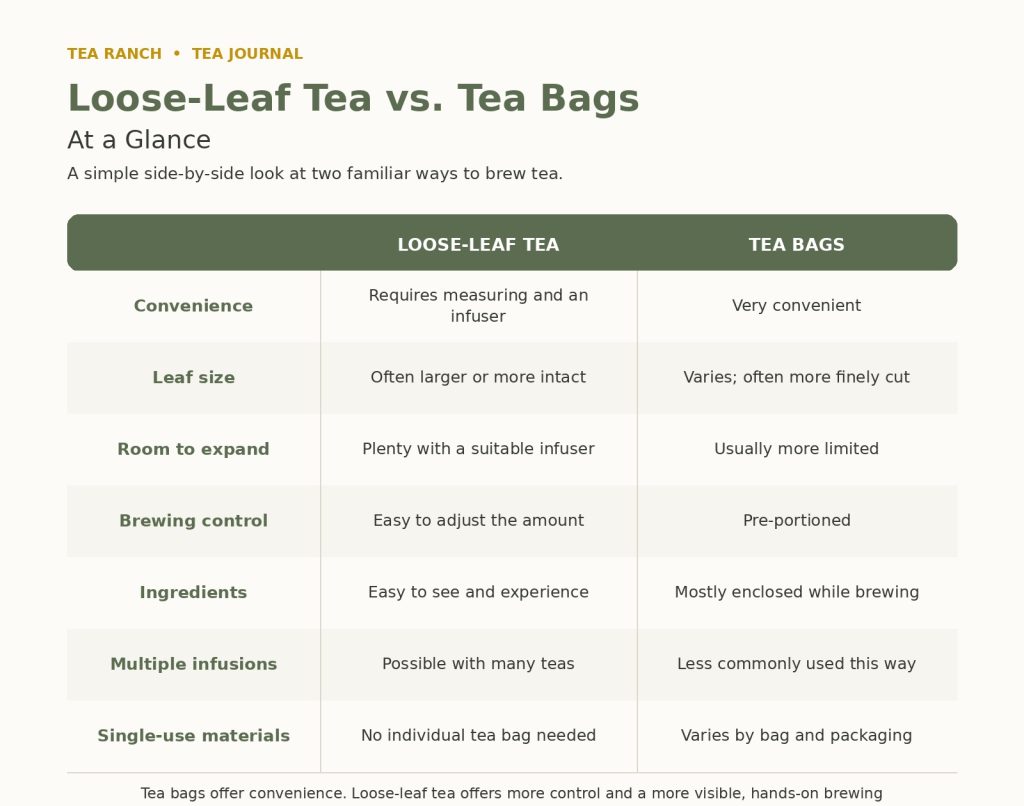
Tea bags win hands down when convenience is the priority.
They're easy to pack for work or travel, require virtually no cleanup, and don't require an infuser.
If you're rushing out the door in the morning, there is nothing wrong with appreciating that simplicity.
Loose-leaf tea asks just a little more of you.
You measure it. You give the leaves room to steep. You strain them. You clean the infuser afterward.
But that's also part of its appeal.
The extra effort is actually very small, and sometimes those few extra minutes are exactly the point.
Neither method needs to be the "right" one.
It's really a question of what you want from your cup.
Why We Chose Loose Leaf at Tea Ranch
When we created Tea Ranch, we wanted tea to be about more than something you quickly drink on your way to the next thing.
We wanted opening a jar to be part of the experience.
Seeing the leaves and botanicals. Smelling the blend. Scooping out the tea.
Watching it steep.
And having a few minutes when nothing particularly urgent needs to happen.
That's one reason we chose loose leaf for our teas.
It also fits something at the heart of Tea Ranch: finding small opportunities to slow down and notice what's around us.
Making loose-leaf tea isn't complicated. It simply asks for a little participation.
And we think that's rather nice.
Curious About Loose-Leaf Tea? Start Simple.
If you've only ever brewed tea bags, you don't need special knowledge or an elaborate tea setup to try loose leaf.
All you really need is:
Tea + an infuser + fresh water + a mug.
Start with the brewing directions for your tea and adjust from there.
Before long, measuring the leaves and setting them to steep becomes as natural as dropping a tea bag into a cup.
If you need a little help getting started, read our Tea Journal guide, How to Brew the Perfect Cup of Loose-Leaf Tea, where we cover tea-to-water ratios, water temperatures, steeping times, and some of the most common brewing mistakes.
And then?
Give the leaves a little room, give yourself a few minutes, and see what you've been missing.
Happy steeping,
Annika
Founder, Tea Ranch